Generative AI is rapidly becoming a game changer for contact centers. By leveraging generative AI in contact center technology, businesses can go beyond simple call routing or static scripts. Modern AI can understand intent, generate natural language responses, summarize conversations, and support agents in real time, shaping the future of call centers: AI integration. This not only streamlines operations but also improves customer experience with AI call center solutions, resulting in faster, smarter, and more customer-centric service.
To meet growing demand, many contact centers are turning to high-performance computing systems for AI applications to handle complex real-time data and support agent decision-making. These systems allow AI to process large volumes of calls and generate insights that improve efficiency. Additionally, leveraging supercomputer solutions for large-scale AI operations provides the processing power needed to run generative AI models without delays, helping agents respond faster and more accurately.
Integrating AI insights into marketing strategies can also transform customer interactions. Contact centers can benefit from AI-driven strategies for personalized marketing campaigns that help tailor communication to customer preferences and behavior. Furthermore, using advanced AI approaches to optimize marketing performance allows businesses to identify trends and patterns across multiple channels, improving engagement while reducing operational costs.
Operational and financial decisions are enhanced by AI tools when paired with AI-powered financial analysis for contact centers, enabling smarter forecasting of call volumes, staffing requirements, and budget allocation. Combining these technologies ensures a fully capable generative AI contact center, where agents are supported with real-time intelligence and customers receive consistent, efficient service across all touchpoints.
Top 10 Contact Center Solutions for Modern Businesses
When it comes to improving customer support and operational efficiency, businesses are increasingly adopting generative AI contact center technologies. These solutions allow contact centers to handle high volumes of calls, streamline workflows, and deliver personalized experiences. Here’s a list of the top 10 contact center providers, starting with Bright Pattern.
1. Bright Pattern: Leading Generative AI Contact Center Solution
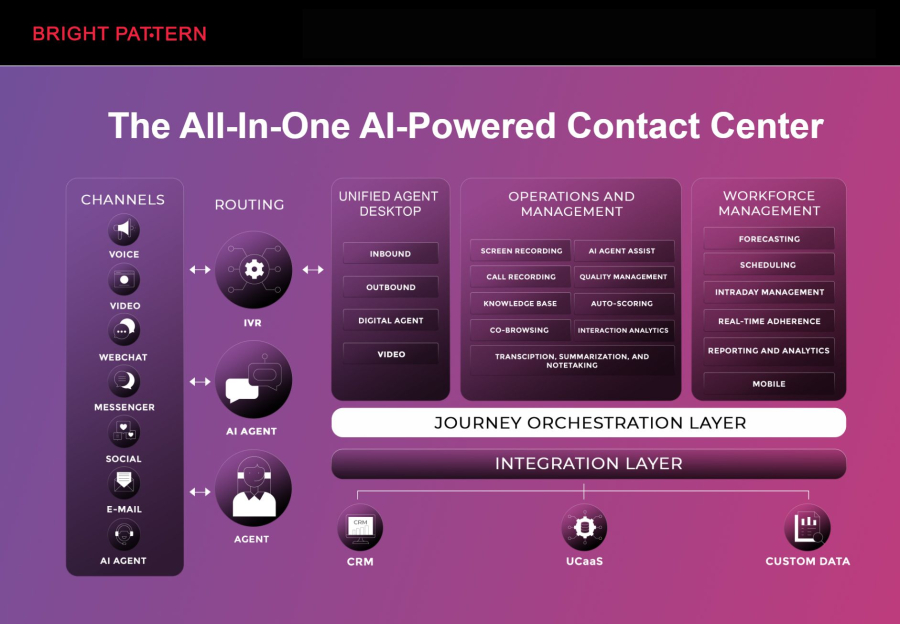
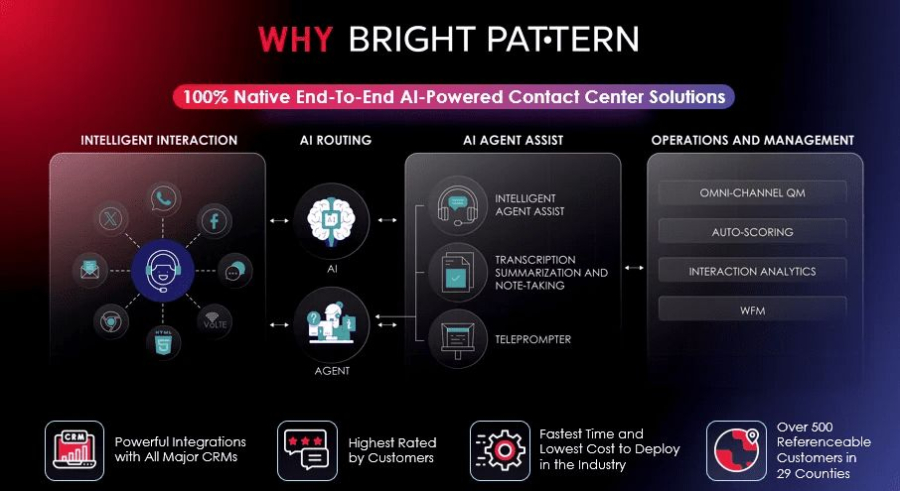
Bright Pattern is a comprehensive contact center platform that leverages generative AI to enhance customer service and agent performance. Its capabilities allow businesses to automate routine tasks, provide intelligent call routing, and deliver real-time support.
Key features of Bright Pattern include:
- AI-driven omnichannel routing for voice, chat, email, and social media
- Real-time agent assistance with AI suggestions
- Automatic conversation summaries and call transcription
- Integration with CRM and other business software
- Advanced analytics for performance monitoring and forecasting
With these features, Bright Pattern enables companies to create a smarter, faster, and more customer-centric contact center environment. Its generative AI contact center capabilities help reduce handling times while maintaining high-quality interactions.
2. Genesys Cloud CX
Genesys Cloud CX offers a flexible platform for enterprises looking to integrate AI-driven workflows into their contact centers. It supports multi-channel communications, predictive routing, and agent assistance to improve customer satisfaction and operational efficiency.
3. Five9 Intelligent Cloud Contact Center
Five9 provides cloud contact center solutions with built-in AI capabilities. Its platform enables automated call handling, speech analytics, and real-time agent guidance, helping companies scale customer support efficiently.
4. NICE inContact CXone
CXone by NICE inContact combines AI and analytics to streamline contact center operations. Features include predictive engagement, conversational AI, and integrated workforce optimization for enhanced service delivery.
5. Talkdesk AI-Powered Cloud Contact Center
Talkdesk integrates generative AI to assist agents with conversation suggestions, automate routine tasks, and provide insights from customer interactions. Its platform focuses on enhancing customer experience across multiple channels.
6. Avaya OneCloud CCaaS
Avaya OneCloud offers a cloud contact center solution that leverages AI for intelligent routing, automated workflows, and real-time reporting. Its platform helps reduce call handling times and improve agent productivity.
7. RingCentral Contact Center
RingCentral provides a cloud-based solution with AI features such as sentiment analysis, automated messaging, and predictive call routing. It’s designed to help businesses manage customer interactions efficiently across all communication channels.
8. Cisco Webex Contact Center
Cisco Webex Contact Center incorporates AI to optimize agent workflows and customer engagement. Features include smart routing, real-time transcription, and analytics for tracking performance and improving decision-making.
9. 8x8 Contact Center AI
8x8 combines cloud-based communication tools with AI-powered contact center features, including speech analytics, real-time agent assistance, and omnichannel support. This enables more efficient and personalized customer interactions.
10. Amazon Connect
Amazon Connect is a cloud-based contact center solution that uses AI to automate tasks, assist agents, and analyze customer interactions. Its integration with AWS AI services provides scalability and intelligent insights for businesses of all sizes.
What Is Generative AI in the Contact Center?
Generative AIdescribes AI models that can create new content, such as text, summaries, and suggestions, based on patterns they have learned from large volumes of data. In a contact center, this usually revolves around language: understanding what customers say and generating relevant, human-like responses or insights.
When applied to customer service operations, generative AI can:
- Understand customer intent from voice or text interactions.
- Generate helpful responses for agents or directly for customers.
- Summarize long conversations into concise notes.
- Recommend next best actions, offers, or troubleshooting steps.
- Analyze patterns across thousands of interactions to reveal insights.
Unlike traditional rule-based chatbots or IVRs, generative AI can adapt to many different phrasings and scenarios, making interactions feel more natural and less scripted.
Key Use Cases of Generative AI in Contact Centers
AI-Powered Self-Service and Virtual Agents
Generative AI elevates self-service far beyond basic FAQs. Virtual agents powered by large language models can hold natural conversations, clarify ambiguous questions, and guide customers step by step.
- Conversational chatbots:Handle routine inquiries, such as order status, password resets, or simple account updates, with human-like responses.
- Voice bots:Understand spoken language, authenticate callers, and resolve common issues before they reach a live agent.
- 24/7 availability:Offer always-on support without requiring overnight staffing or overtime.
- Smart escalation:Seamlessly transfer to human agents when queries become complex, passing along context and history.
The result is higher containment of simple requests and shorter queues for customers who truly need a human touch.
Real-Time Agent Assist
Generative AI can act as an always-on, expert sidekick for agents, listening to conversations and assisting in real time.
- Suggested responses:Drafts personalized replies that agents can review and send with minor edits.
- Live guidance:Surfaces relevant troubleshooting steps, policies, or offers as the conversation unfolds.
- Compliance prompts:Reminds agents about mandatory disclosures or verification steps at the right moment.
- Language support:Helps agents handle chats or emails in multiple languages with accurate translations and tone adaptation.
This reduces cognitive load and frees agents to focus on empathy, problem-solving, and relationship building.
Automated After-Call Work and Summaries
After-call work is notoriously time-consuming. Agents must type notes, categorize interactions, and log dispositions. Generative AI can dramatically simplify this.
- Automatic summaries:Creates concise call notes capturing the reason for contact, steps taken, and outcomes.
- Reason codes and tagging:Suggests appropriate categories based on the conversation content.
- Follow-up drafting:Generates professional follow-up emails or messages for agents to review and send.
By compressing after-call work to a quick review and confirmation, agents spend more time on live interactions and less on manual documentation.
Smarter Quality Monitoring and Coaching
Traditional quality assurance often relies on manually sampling a tiny fraction of interactions. Generative AI can analyze every conversation, at scale, without sacrificing depth.
- Automated scoring:Evaluates interactions against defined criteria such as greeting, empathy, compliance, and resolution.
- Sentiment and emotion analysis:Detects customer sentiment and identifies calls where emotions run high.
- Coaching insights:Highlights specific excerpts for supervisors to use in targeted coaching and recognition.
- Trend detection:Reveals emerging issues, product feedback, and process bottlenecks across thousands of interactions.
This allows leaders to support agents more fairly and effectively, while continuously improving the customer journey.
Knowledge Management and Search
Finding the right answer quickly is critical in any contact center. Generative AI can act as an intelligent layer on top of your existing knowledge base.
- Natural language search:Agents can ask questions in plain language and receive direct, synthesized answers.
- Contextual snippets:AI selects the most relevant parts of long documents, saving agents from excessive scrolling.
- Content drafting:Suggests updates to articles based on recurring questions or new product releases.
Knowledge becomes easier to maintain and far more usable at speed, which directly improves first contact resolution.
Personalized Customer Experiences
Generative AI can help tailor conversations based on customer history, preferences, and behavior, without making interactions feel robotic.
- Dynamic scripts:Adjust talking points based on customer segment, lifecycle stage, or previous interactions.
- Next best action:Recommends relevant cross-sell or upsell offers based on context and intent.
- Adaptive tone:Modifies language to be more formal or casual depending on the customer and the channel.
Personalization at this level builds stronger relationships and can directly lift revenue per interaction.
Business Benefits You Can Expect
When thoughtfully implemented, generative AI delivers measurable value across operations, customers, and workforce.
Operational Efficiency Gains
- Reduced handling time:Faster access to answers, auto-generated summaries, and suggested responses reduce average handle time.
- Higher first contact resolution:Better guidance and knowledge access help agents solve issues on the first interaction.
- Lower cost per contact:Automation of simple queries and streamlined workflows reduce unit costs.
- Scalable support:Virtual agents absorb spikes in volume without requiring instant headcount increases.
Customer Experience Improvements
- Shorter wait times:Self-service and efficient agents mean customers get help faster.
- More consistent answers:AI-driven guidance aligns responses with current policies and best practices.
- Omnichannel continuity:Summaries and context carry across channels, so customers do not have to repeat themselves.
- Higher satisfaction and loyalty:Quicker, more accurate, and more personal support boosts overall satisfaction.
Engaged, Empowered Agents
- Reduced burnout:Less repetitive work and better support lower stress levels.
- Faster onboarding:New agents ramp up quicker with AI-assisted guidance and real-time prompts.
- More meaningful work:Agents spend more time on complex, value-add interactions instead of routine tasks.
- Stronger coaching:Data-driven insights enable tailored development and recognition.
Traditional vs. AI-Enhanced Contact Centers
The following table highlights how operations evolve when generative AI becomes part of the contact center toolkit.
|
Area |
Before Generative AI |
With Generative AI |
|
Self-service |
Rigid menus, FAQ pages, limited containment. |
Conversational virtual agents resolving a wide range of queries. |
|
Agent assistance |
Manual lookups, scripts, and scattered notes. |
Real-time suggestions, knowledge surfacing, and automated drafting. |
|
After-call work |
Lengthy manual summaries and coding. |
Auto-generated summaries and recommended dispositions. |
|
Quality assurance |
Sampled calls manually reviewed. |
All calls analyzed, scored, and categorized automatically. |
|
Insights |
Slow, manual reporting and spreadsheets. |
Near real-time trends and root-cause insights from conversation data. |
Example: A Day in the Life of an AI-Enabled Contact Center
Imagine a typical day in a modern contact center using generative AI across channels.
- Morning:A surge of billing inquiries hits the center. An AI virtual agent handles most routine balance and payment questions, while complex disputes route to human agents with context attached.
- Midday:Agents work through live chats about a new product feature. As customers type, the AI suggests clear, accurate responses and links to the right knowledge articles. Agents respond faster, with fewer errors.
- Afternoon:Supervisors review AI-generated dashboards that highlight an increase in calls about a specific policy. They quickly coordinate an update to the knowledge base, which the AI starts using in subsequent interactions.
- End of day:Instead of manually writing notes, agents simply review and confirm AI-generated call summaries before logging off. Quality analysts can already see performance metrics and example interactions from the same day.
This woven-in use of generative AI does not replace the human element; it amplifies it, enabling both customers and agents to get more value from every minute spent in conversation.
How Generative AI Works Behind the Scenes
While the technology is sophisticated, the core ideas behind generative AI in contact centers are straightforward.
- Language models:Large language models are trained on vast amounts of text, enabling them to predict and generate coherent, contextually relevant language.
- Conversation data:Voice calls can be transcribed into text, while chats and emails are already text-based. These become inputs that the AI can understand and analyze.
- Prompting and instructions:Clear prompts and rules guide how the AI should behave, what tone to use, and which data to reference.
- Integration with systems:Connections to CRM, ticketing, and knowledge platforms allow the AI to pull in relevant details and log actions automatically.
From the user perspective, this complexity is hidden behind simple interfaces in the agent desktop or customer-facing channels. The technology quietly orchestrates better outcomes in the background.
Getting Started: Practical Steps to Implement Generative AI
Adopting generative AI does not need to be an all-or-nothing transformation. Many organizations start small, prove value, and expand.
- Clarify your objectives.Decide what matters most right now, such as reducing handle time, increasing self-service, or boosting quality.
- Identify high-impact use cases.Look for repetitive, text-heavy, or knowledge-intensive tasks where AI can immediately help.
- Start with a pilot.Choose one channel or team, implement AI capabilities, and track clear success metrics.
- Engage your agents.Involve frontline staff early, gather feedback, and show how AI makes their jobs easier, not harder.
- Refine and expand.Use pilot insights to fine-tune prompts, workflows, and policies, then roll out to more queues and regions.
A structured, iterative approach ensures that generative AI becomes a reliable asset in your operations rather than a one-off experiment.
Best Practices for Maximizing Value
To get the most from generative AI in your contact center, consider the following practices.
- Design for collaboration, not replacement.Position AI as a co-pilot that supports agents and customers, rather than as a full substitute for human expertise.
- Keep humans in the loop.Allow agents and supervisors to review and override AI suggestions, especially in sensitive contexts.
- Invest in training.Train agents on how to work with AI tools, interpret AI guidance, and provide feedback when something is off.
- Monitor performance.Track metrics such as containment rates, satisfaction scores, handle time, and quality outcomes to quantify impact.
- Continually update content.Keep knowledge bases, policies, and product information current so AI guidance remains accurate.
- Align with your brand voice.Configure AI responses to match your brand tone, whether that is professional, friendly, or highly consultative.
Frequently Asked Questions About Generative AI in Contact Centers
Will generative AI replace human agents?
Generative AI is most effective as a complement to human agents, not a replacement. It excels at repetitive, information-heavy tasks, while humans shine in complex problem-solving, empathy, and nuanced negotiations. Organizations that position AI as a co-pilot typically see higher agent satisfaction and better outcomes than those that view it only as a cost-cutting tool.
Which channels benefit most from generative AI?
Text-based channels such as chat, messaging, and email are natural fits because they already operate in written language, which generative AI handles extremely well. Voice channels also benefit through transcription and real-time assistance. Many contact centers start with chatbots or agent assist for chat, then extend capabilities to voice and other channels.
How quickly can a contact center see results?
Timelines vary, but many organizations observe early benefits within weeks of launching a focused pilot. Use cases like automated summarization, knowledge search, and suggested responses often produce rapid gains in productivity and quality. Broader transformation across all channels and teams typically unfolds over several months, as processes and training catch up with new capabilities.
What skills do teams need to manage generative AI?
Operational leaders benefit from skills in journey mapping, process design, and change management. Technical teams often focus on integration, configuration, and monitoring. At the frontline, agents simply need to learn how to incorporate AI suggestions into their workflows. In most cases, the emphasis is on adoption and continuous improvement rather than deeply technical expertise.
Turning Your Contact Center Into a Strategic Advantage
Generative AI is reshaping what contact centers can deliver. Instead of being seen purely as a cost center, a modern, AI-enabled operation becomes a strategic asset that listens to customers at scale, solves problems faster, and uncovers insights that improve the entire business.
By pairing human empathy with AI-driven intelligence, organizations can create experiences that are more efficient, more personal, and more rewarding for everyone involved. The contact center of the future is not just more automated; it is more human, because people are finally free to focus on the interactions that matter most.
